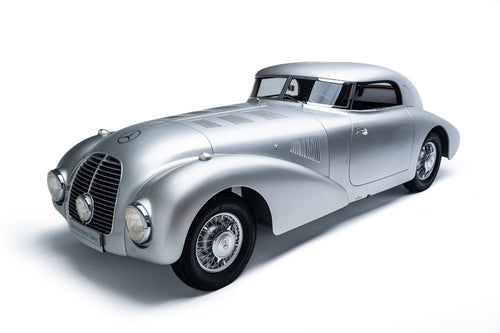
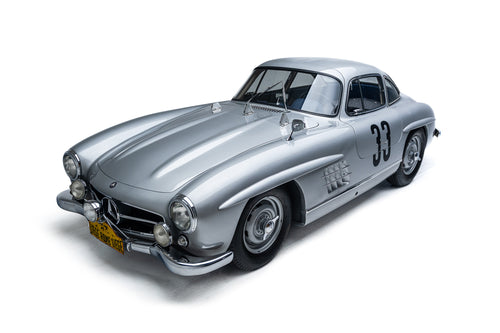
The 300 SL was the first Mercedes-Benz racing model introduced after World War II and is credited with reintroducing the Mercedes-Benz works team to international competition. This experimental prototype was developed for the 1953 racing season based on the 1952 Le Mans–winning 300 SL. Created by Rudolf Uhlenhaut, it was intended to add 21 percent more power and 7 percent more torque to the 300 SL’s design while reducing overall weight by 155 pounds. A shortened wheelbase and 16-inch wheels improved traction, while a new cast-aluminum transmission reduced weight. Its engine utilized direct fuel injection, making this prototype the first functional Mercedes-Benz vehicle to do so.
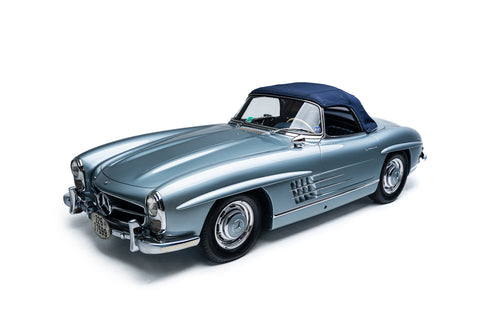
Streamlined bodywork by Walter Gragert earned it the nickname “Hobel” (German for “slicer”) in reference to the peaked hood crease, which resembled a carpenter’s plane. While 10 examples were planned, only one was built before Mercedes-Benz halted development to focus on its 1954 Formula One program. The Hobel’s styling ultimately previewed the look of the production Mercedes-Benz 300 SL, which, when offered in 1954, was largely responsible for popularizing the marque in the American market.
Vehicle imagery may be used for personal, media editorial, or educational purposes. Please credit Petersen Automotive Museum, petersen.org, if used. Photos may not be used for commercial purposes.