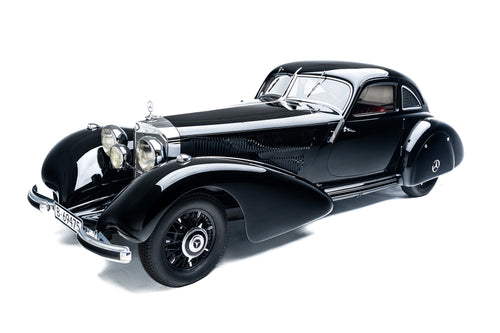
As rising speeds and new highways reshaped automotive travel in the 1930s, engineers increasingly focused on aerodynamics and high-speed stability. Built in 1938 on the 540 K chassis, the one-off 540 K Stromlinienwagen (Streamliner) featured a lightweight aluminum body developed through wind tunnel testing. Its tapered form, enclosed underbody, and carefully integrated details reduced drag to an exceptional coefficient of 0.36, enabling sustained travel at over 100 mph.
Development of the Streamliner began in 1937 for the planned—but ultimately canceled—1938 Berlin–Rome endurance race. However, technical challenges halted its development as a competition car. Instead, it found its purpose with Dunlop, which had sought a vehicle from Mercedes-Benz in 1937 for tire testing at prolonged autobahn speeds. Recognizing the unrealized Streamliner’s suitability for this role, the two companies agreed to complete the car for this purpose, with Dunlop taking delivery in 1938.