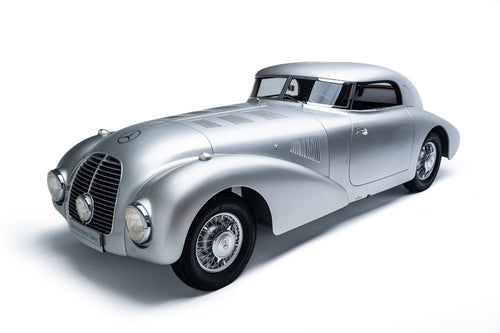
While Grand Prix racing prior to the 1930s had been dominated first by the French and later by the Italians, German manufacturers, funded by the Nazi regime to showcase Germany's industrial prowess, rose to prominence in the 1930s. This period became known as the “Silver Arrows” era, a nickname derived from the German cars’ unpainted metal bodywork and now closely associated with Mercedes-Benz’s Formula One race cars.
Introduced in 1938, the W 154 took victory in three of four races in each of the 1938 and 1939 European Grand Prix Championship seasons. Just 16 examples were built. This chassis, known as “Wagen 7,” was constructed for Rudolf Caracciola’s aborted 1938 Indianapolis 500 entry, but instead debuted with a victory at the German Grand Prix at the Nürburgring, driven by Dick Seaman. In 1939, Wagen 7 received a revised engine and was driven by Hermann Lang to four major victories—including two European Championship races—making it the most successful of the W 154s.
Courtesy of the Keller Collection at the Pyramids
Location: World-Class: 100 Years of Mercedes-Benz
1938 Mercedes-Benz W 154 Gallery
Vehicle imagery may be used for personal, media editorial, or educational purposes. Please credit Petersen Automotive Museum, petersen.org, if used. Photos may not be used for commercial purposes.